Tiger
Tiger is the largest animal in the cat family. Tiger is only in Asia. It is the member of genus panthera. It scientific name is panthera Tigris . It is an carnivore. They live in Savannah and Tropical green forest areas.

Tiger species

Bengal Tiger

The Bengal tiger is a tiger from a specific population of the Panthera tigris tigris subspecies that is native to the Indian subcontinent.[3] It is threatened by poaching, loss, and fragmentation of habitat, and was estimated at comprising fewer than 2,500 wild individuals by 2011. None of the Tiger Conservation Landscapes within its range is considered large enough to support an effective population of more than 250 adult individuals.[1] India’s tiger population was estimated at 1,706–1,909 individuals in 2010.[4] By 2018, the population had increased to an estimated 2,603–3,346 individuals.[5] Around 300–500 tigers are estimated in Bangladesh, 220–274 tigers in Nepal and 103 tigers in Bhutan.
Sumatran Tiger
The Sumatran tiger is a population of Panthera tigris sondaica in the Indonesian island of Sumatra. This population was listed as Critically Endangered on the IUCN Red List in 2008, as it was estimated at 441 to 679 individuals, with no subpopulation larger than 50 individuals and a declining trend.
The Sumatran tiger is the only surviving tiger population in the Sunda Islands, where the Bali and Javan tigers are extinct.[4] Sequences from complete mitochondrial genes of 34 tigers support the hypothesis that Sumatran tigers are diagnostically distinct from mainland subspecies.
In 2017, the Cat Classification Task Force of the Cat Specialist Group revised felid taxonomy and recognizes the living and extinct tiger populations in Indonesia as P. t. sondaica.
Siberian Tiger

The Siberian tiger is a population of the Panthera tigris tigris subspecies that is native to the Russian Far East, Northeast China,[3] and possibly North Korea.[4] It once ranged throughout the Korean Peninsula, north China, and eastern Mongolia. Today, this population inhabits mainly the Sikhote-Alin mountain region in southwest Primorye Province in the Russian Far East. In 2005, there were 331–393 adult and subadult Siberian tigers in this region, with a breeding adult population of about 250 individuals. The population had been stable for more than a decade because of intensive conservation efforts, but partial surveys conducted after 2005 indicate that the Russian tiger population was declining. An initial census held in 2015 indicated that the Siberian tiger population had increased to 480–540 individuals in the Russian Far East, including 100 cubs. This was followed up by a more detailed census which revealed there was a total population of 562 wild Siberian tigers in Russia
Caspian Tiger

The Caspian tiger was a tiger from a specific population of the Panthera tigris tigris subspecies that was native to eastern Turkey, northern Iran, Mesopotamia, the Caucasus around the Caspian Sea, Central Asia to northern Afghanistan, and Xinjiang in western China. It inhabited sparse forests and riverine corridors in this region until the 1970s. This population was assessed as extinct in 2003.
Felis virgata was a scientific name used since its 1815 naming by Johann Karl Wilhelm Illiger for tigers of this zone.[7] It was seen as a distinct subspecies, most often as Panthera tigris virgata. However, results of phylogeographic analysis evinces that the Caspian and Siberian tiger populations shared a common continuous geographic distribution until the early 19th century.
Some Caspian tigers were intermediate in size between Siberian and Bengal tigers.
It’s was also called the Balkhash tiger, Hyrcanian tiger, Turanian tiger, and the Mazandaran tiger (Persian: ببرِ مازندران), by local communities.
Malayan Tiger
The Malayan tiger is a tiger from a specific population of the Panthera tigris tigris subspecies that is native to Peninsular Malaysia. This population inhabits the southern and central parts of the Malay Peninsula and has been classified as critically endangered on the IUCN Red List in 2015. The population was estimated at 250 to 340 adult individuals in 2013 and likely comprises less than 200 mature breeding individuals and has a declining trend.In the Malay language, the tiger is called harimau, also abbreviated to rimau.[6] It is also known as the southern Indochinese tiger, to distinguish it from tiger populations in northern parts of Indochina, which are genetically different to this population.
The Indo – Chinese Tiger
The Indochinese tiger is a tiger from a specific population of the Panthera tigris tigris subspecies that is native to Southeast Asia. This population occurs in Myanmar, Thailand, and Laos. It has been listed as endangered on the IUCN Red List since 2008, as the population seriously declined and approaches the threshold for critically endangered. In 2011, the population was thought to comprise 342 individuals, including 85 in Myanmar and 20 in Vietnam, with the largest population unit surviving in Thailand estimated at 189 to 252 individuals during 2009 to 2014
The South China Tiger
The South China tiger is a tiger from a specific population of the Panthera tigris tigris subspecies that is native to southern China. The population mainly inhabited the Fujian, Guangdong, Hunan and Jiangxi provinces. It has been listed as Critically Endangered on the IUCN Red List since 1996 and is possibly extinct in the wild since no wild individual has been recorded since the late 1980s. In the late 1990s, continued survival was considered unlikely because of low prey density, widespread habitat degradation and fragmentation, and other human pressures. In the fur trade, it used to be called Amoy tiger.
The Javan Tiger
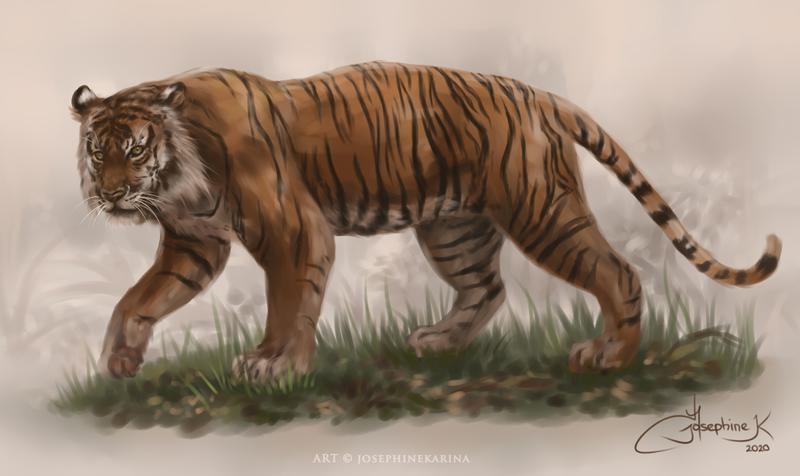
The Javan tiger was a population of Panthera tigris sondaica, which lived in the Indonesian island of Java until the mid 1970s.[3][4] This population was hunted to extinction and its natural habitat converted for human use.[1] It was one of the three tiger populations in the Sunda Islands.
The Balinese Tiger
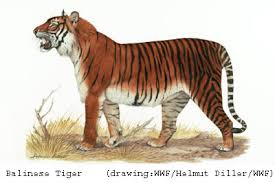
The Bali tiger was a population of Panthera tigris sondaica, which lived in the Indonesian island of Bali.[2] This population has been extinct since the 1950s.
It was formerly regarded as a distinct tiger subspecies, under the scientific name Panthera tigris balica, which had been assessed as extinct on the IUCN Red List in 2008.[1] In 2017, felid taxonomy was revised and this subspecies subordinated to P. t. sondaica, which also includes the still surviving Sumatran tiger.[2]
Results of mitochondrial DNA analysis of 23 tiger samples from museum collections indicate that tigers colonized the Sunda Islands throughout the last glacial period 11,000–12,000 years ago.[3] In Bali, the last tigers were recorded in the late 1930s. A few individuals likely survived into the 1940s and possibly 1950s. This population was hunted to extirpation and its natural habitat converted for human use.
 www.atob.in